
Call us toll free:
8619709992541 [email protected]
Jctprint Machinery Co., Ltd
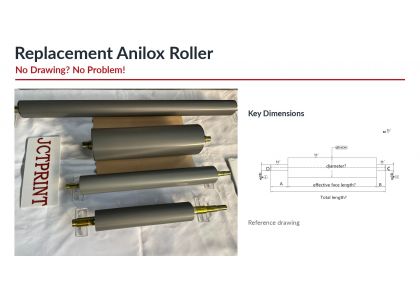
When an anilox roller becomes worn, damaged, or no longer delivers the required ink transfer performance, replacing it may be necessary to maintain consistent production quality.
However, many printing companies face a common problem: the original anilox roller drawing is missing, the equipment manufacturer no longer provides technical documentation, or the original roller specifications are unknown.
Can you order a replacement anilox roller without a technical drawing?
Yes. In many cases, a custom replacement anilox roller can be manufactured by confirming the machine model, existing roller dimensions, installation structure, and printing requirements.
This guide explains what information you need to prepare and how to obtain a suitable replacement anilox roller.
If you do not have an original technical drawing, identifying your machine is a good starting point.
The following information can help an anilox roller manufacturer understand your equipment configuration:
Printing machine brand and model
Machine serial number, if available
Year of manufacture
Printing width
Number of printing colors
Photos of the machine and its nameplate
Different printing machines may require different roller structures, installation methods, and dimensional tolerances.
JCTPRINT provides customized anilox rollers and anilox sleeves for various printing equipment, including machines from W&H, BOBST, COMEXI, Nilpeter, Mark Andy, and other manufacturers.
However, even machines of the same model may have different configurations. The final roller dimensions should always be confirmed before production.
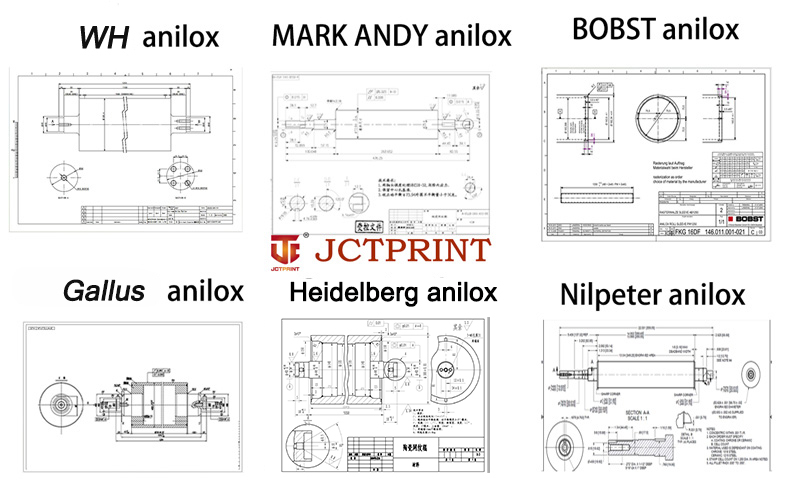
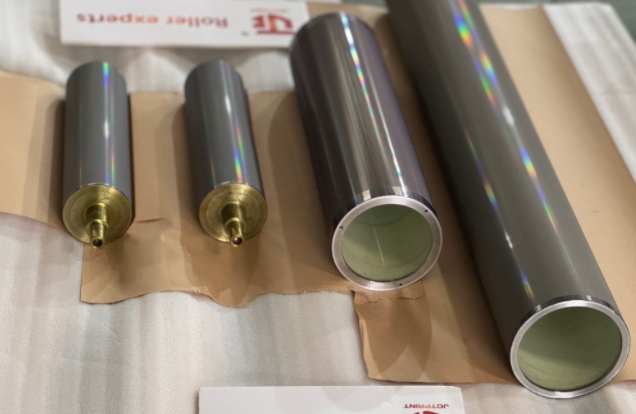
Before ordering a replacement, it is important to identify the structure and material of your existing anilox roller.
The most common types include:
| Anilox Roller Type | Typical Applications |
|---|---|
| Ceramic anilox roller with shaft | Narrow-web, stack-type and inline flexo printing |
| Ceramic anilox sleeve | CI and wide-web flexo printing |
| Chrome-plated anilox roller | Selected corrugated printing and other ink transfer applications |
A shaft-type anilox roller and an anilox sleeve have different mounting structures and dimensional requirements.
If you are unsure which type you need, simply provide photographs of your existing roller, including its overall appearance and both ends.
These photographs can help the manufacturer's technical team identify the roller structure and determine what additional information is required.
When an original drawing is unavailable, the existing anilox roller can serve as a reference for dimensional confirmation.
The main dimensions to confirm include:
Roller outer diameter
Engraved face length
Overall roller length
Shaft diameters and lengths at both ends
Bearing journal dimensions
Distance between bearing journals
Gear mounting dimensions
Keyway dimensions, if applicable
Threaded holes and other installation details
The main dimensions to confirm include:
Outer diameter
Inner diameter
Overall sleeve length
Engraved face length
Wall thickness
End structure
Positioning slots or notches, if applicable
Mounting mandrel specifications
Accurate measurements are essential to ensure that the replacement roller fits the existing equipment correctly.
Incorrect dimensions may result in installation difficulties, excessive vibration, unstable operation, or additional production downtime.
If the existing roller is severely worn or damaged, its measurements may no longer represent the original specifications. In this case, additional confirmation of the machine's installation dimensions may be necessary.
Mechanical dimensions determine whether an anilox roller fits the machine, while engraving specifications determine its ink transfer characteristics.
Two of the most important engraving parameters are LPI and BCM.
LPI refers to the number of engraved cells per linear inch of the anilox roller.
Different line screens are suitable for different printing requirements, including solid areas, fine text, line work, and halftone printing.
BCM represents the ink-carrying volume of the engraved cells per unit of surface area.
Cell volume directly influences the amount of ink available for transfer during printing.
Some manufacturers use metric units instead of LPI and BCM.
| Parameter | Imperial Unit | Metric Unit |
|---|---|---|
| Line screen | LPI | LPCM |
| Cell volume | BCM | cm³/m² |
The approximate conversion relationships are:
1 LPCM = 2.54 LPI
1 BCM = 1.55 cm³/m²
If the original roller has engraved markings or identification labels, photographs of these markings can help identify its original specifications.
Not knowing the original engraving specifications does not necessarily prevent you from ordering a replacement anilox roller.
A suitable engraving specification can be recommended based on your actual printing or coating requirements.
The following information is particularly useful:
Type of ink: water-based, solvent-based, or UV ink
Printing substrate
Printing plate line screen
Solid printing, fine text, or halftone printing requirements
Required ink coverage or coating amount
Current printing quality problems
Normal production speed
For example, solid-area printing generally requires sufficient cell volume to achieve the desired ink coverage, while fine text and halftone printing often require a higher line screen and appropriately controlled ink volume.
For coating and varnishing applications, the required coating weight and coating material characteristics should also be considered.
If the original anilox roller has been used for many years, simply copying its existing cell volume may not be the best solution. Wear and cell blockage can cause the measured volume to differ from its original specification.
At JCTPRINT, our technical team can assist customers in selecting suitable LPI, BCM, and cell geometry according to their production requirements.
Clear photographs are especially helpful when ordering a replacement anilox roller without a drawing.
We recommend preparing the following photographs:
Full view of the existing anilox roller
Close-up of the drive-side shaft or sleeve end
Close-up of the opposite end
Gear, bearing, and keyway structures
Roller surface and engraved markings
Roller installation position inside the machine
Machine nameplate
These photographs help the technical team understand the roller's mechanical structure and identify important installation details.
A short video showing the roller and its mounting position may also be helpful.
However, photographs alone cannot guarantee dimensional accuracy. Critical measurements must be confirmed before manufacturing.
JCTPRINT provides customized ceramic anilox rollers, anilox sleeves, and chrome-plated anilox rollers for printing, coating, and varnishing applications.
Our custom replacement process includes the following steps:
Our team collects the machine information, roller photographs, available dimensions, engraving specifications, and application requirements.
Our technical team reviews the information and confirms the mechanical structure, critical dimensions, roller material, LPI, BCM, and engraving geometry with the customer.
A technical drawing can be prepared based on sufficient dimensional information for confirmation before production.
The anilox roller is manufactured according to the confirmed technical specifications.
For ceramic anilox rollers, our manufacturing capabilities include:
Precision roller body machining
Plasma ceramic coating technology
High-precision ALE laser engraving
Customized cell geometry and volume
Dynamic balancing
Before shipment, the finished anilox roller undergoes quality inspections covering:
Roller dimensions and dimensional tolerances
Surface quality
Radial runout
Dynamic balance
Engraved cell geometry
Anilox cell volume
AniCAM inspection technology is used to verify engraving quality and cell volume.
After final inspection, the roller is carefully protected and securely packaged for international transportation.
Our goal is to provide a replacement anilox roller that meets both the mechanical installation requirements and the actual printing or coating needs of the customer.
Before requesting a quotation, prepare as much of the following information as possible.
| Required Information | Details |
|---|---|
| Machine information | Brand, model, serial number |
| Roller type | Shaft-type roller or anilox sleeve |
| Roller material | Ceramic or chrome-plated |
| Roller dimensions | Diameter, face length, overall length and mounting dimensions |
| Engraving specifications | LPI, BCM and cell geometry, if known |
| Application | Flexo printing, corrugated printing, coating or varnishing |
| Ink or coating type | Water-based, solvent-based, UV or other coating materials |
| Photos | Existing roller, both ends and machine nameplate |
| Quantity | Number of replacement rollers required |
You do not need to have all this information before contacting a manufacturer. Start with the information you already have, and the technical team can help identify what else is needed.
The machine model is a useful starting point. However, additional dimensions or installation details may be required to ensure compatibility with your specific equipment.
Yes. An existing roller can provide a reference for dimensional measurement and structural confirmation. Severely worn or damaged areas may require additional verification.
A suitable cell volume can be recommended based on the engraving geometry, ink type, printing plate, substrate, and required ink coverage.
Yes. Replacement is also an opportunity to optimize the engraving specifications according to your current printing requirements, rather than simply reproducing the original roller.
Yes. You can send your machine model, available roller dimensions, photographs, and application requirements to start the quotation process. The final quotation may require further technical confirmation.
Ordering a replacement anilox roller without an original drawing is possible when the necessary mechanical dimensions, installation details, and engraving requirements can be confirmed.
Whether you need a replacement ceramic anilox roller, an anilox sleeve, or a chrome-plated anilox roller, JCTPRINT can provide customized solutions based on your equipment and production requirements.
Don't have a technical drawing? No problem.
Send us your machine model, existing roller photographs, or available dimensions. Our technical team will assist you in confirming the specifications and preparing a customized quotation.
Contact JCTPRINT today for your replacement anilox roller solution.
No Drawing? No Problem!
Simply send us your machine model, roller photos, or available dimensions. Our technical team will help you confirm the specifications and provide a customized solution.


