
Call us toll free:
8619709992541 [email protected]
Jctprint Machinery Co., Ltd
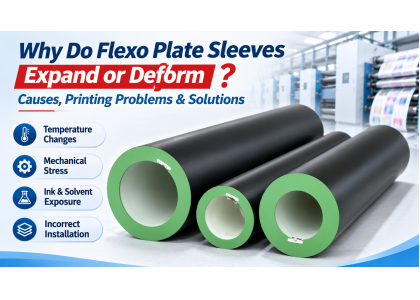
Flexo plate mounting sleeves are essential components in CI flexographic printing and wide-web flexible packaging production. They support printing plates and help maintain the correct printing repeat during operation.
However, some printing companies experience problems such as dimensional changes, sleeve deformation or unstable registration after extended use.
These issues can lead to additional machine adjustments, printing waste and production downtime.
Why do flexo plate sleeves expand or deform, and how can printing companies prevent these problems?
Let's explore the common causes and practical solutions.
Temperature variation is one factor that can affect the dimensions of flexo plate mounting sleeves.
During production, sleeves may be exposed to changes in ambient temperature, machine temperature and operating conditions.
Different materials expand and contract at different rates when temperatures change.
Traditional sleeves often use polyurethane (PU) foam as part of their supporting structure. Depending on the material properties and sleeve construction, temperature changes may contribute to dimensional variation.
For printing applications requiring precise repeat lengths, even relatively small dimensional changes can become important.
How to reduce the risk:
• Maintain stable production temperatures where possible.
• Avoid sudden temperature changes during storage and operation.
• Allow sleeves to reach suitable operating conditions before installation.
• Select sleeve materials with appropriate dimensional stability.
Material selection becomes particularly important for high-precision CI flexographic printing.
Flexo plate sleeves experience repeated mechanical loads during installation, printing and removal.
These loads can include mounting forces, rotational stress and contact pressure during printing.
If a sleeve's internal structure does not provide sufficient support for the application, repeated loading may contribute to gradual deformation.
Potential consequences include:
• Changes in sleeve dimensions
• Uneven contact during printing
• Increased registration adjustments
• Reduced consistency during repeated production runs
The risk depends on sleeve construction, machine settings and operating conditions.
Using a sleeve designed for the required printing speed, dimensions and mechanical loads can help reduce unnecessary stress.
Printing environments involve inks, cleaning agents and other chemicals.
If a sleeve's protective surface or end sealing becomes damaged, liquids may enter its internal structure.
Depending on the materials involved, prolonged exposure can contribute to swelling, deterioration or changes in mechanical properties.
Sleeve ends are particularly important because they may be exposed during installation, removal and cleaning.
How to prevent damage:
• Inspect sleeve ends regularly.
• Avoid using incompatible cleaning chemicals.
• Prevent prolonged contact with ink and solvents.
• Check for cracks or damaged protective layers.
• Use sleeves with suitable end sealing and chemical resistance.
Proper protection of the internal structure helps maintain sleeve performance over time.
Not all sleeve problems are caused by material deformation.
Incorrect installation or poor compatibility between the sleeve and mandrel can also create operating problems that resemble sleeve instability.
Possible causes include:
• Incorrect inner diameter
• Inadequate air pressure during mounting
• Contamination on the mandrel surface
• Damaged sleeve inner surfaces
• Incorrect mounting procedures
These conditions may affect how securely the sleeve fits on the mandrel.
Before assuming that a sleeve has permanently deformed, check the mounting conditions and confirm that its dimensions match the equipment requirements.
Correct installation is essential for stable operation.
Dimensional changes in flexo plate sleeves can affect printing performance in several ways.
Changes in sleeve dimensions or mounting stability may contribute to registration errors.
Operators may need to make additional adjustments to maintain consistent printing results.
The sleeve's effective diameter contributes to the printing repeat.
If the dimensions change beyond acceptable tolerances, the printed repeat may also be affected.
When sleeve dimensions or mounting conditions are inconsistent, additional setup and adjustment may be required.
This can increase machine downtime and material waste.
In demanding CI flexo applications, stable sleeve dimensions are important for maintaining repeatable printing conditions.
However, registration problems can also originate from printing plates, mounting tape, machine settings and other components. Sleeve deformation should be confirmed rather than assumed.
To address the limitations of some conventional sleeve constructions, newer plate mounting sleeves use advanced composite materials.
JCTPRINT's second-generation flexo plate mounting sleeves feature an aramid honeycomb core instead of a traditional PU foam supporting core.
The upgraded structure combines:
• Lightweight aramid honeycomb material
• Composite reinforcement layers
• FiberP hybrid fiber inner base
• Polymer outer surface
• Fully sealed polymer ends
The aramid honeycomb core is designed to provide lightweight structural support with relatively low thermal expansion.
Compared with conventional PU foam core materials, this construction aims to reduce dimensional variation under changing operating conditions.
The composite reinforcement layers help support the sleeve's structural rigidity, while the FiberP inner base is designed to maintain a secure fit on the mandrel.
Fully sealed ends also help protect the internal structure from ink and solvent penetration.
Together, these design features support improved dimensional stability and durability in demanding flexographic printing applications.
Actual performance depends on the complete sleeve construction, specifications and operating conditions.
High-speed CI flexographic printing requires stable mechanical performance throughout production.
During acceleration, continuous operation and deceleration, plate sleeves must maintain their dimensions and fit securely on the mandrel.
A lightweight, rigid sleeve construction can help reduce handling effort while providing the structural support required for demanding printing conditions.
JCTPRINT has documented a flexographic printing application operating at 650 m/min with its second-generation sleeve technology.
This is a specific application reference, not a guaranteed maximum operating speed for every sleeve.
For high-speed printing operations, sleeve selection should consider the machine model, mandrel specifications, printing repeat, sleeve dimensions and actual operating conditions.
When selecting replacement or new flexo plate mounting sleeves, printing companies should evaluate more than the sleeve's outer appearance.
Important factors include:
Core material: Consider the dimensional stability and mechanical properties of the supporting structure.
Sleeve construction: Check the reinforcement layers and overall structural design.
Inner base: Confirm compatibility with the existing mandrel and mounting system.
End protection: Evaluate sealing and resistance to ink and cleaning agents.
Dimensions: Confirm the inner diameter, printing repeat, sleeve length and radial wall thickness.
Operating conditions: Consider printing speed, temperature, cleaning methods and production requirements.
Providing accurate specifications helps manufacturers recommend a suitable sleeve construction.
JCTPRINT manufactures customized flexo plate mounting sleeves for CI flexographic printing and wide-web flexible packaging applications.
Our second-generation sleeves use aramid honeycomb core materials, composite reinforcement, FiberP hybrid fiber inner bases and fully sealed polymer ends.
We support customized dimensions and specifications according to different printing machine requirements.
Whether you are experiencing dimensional instability with existing sleeves or planning to upgrade your printing equipment, our team can help review your technical requirements.
If your printing operation is experiencing sleeve deformation, registration instability or frequent replacement requirements, it may be time to review your sleeve construction and specifications.
Send JCTPRINT your machine model, printing repeat, sleeve dimensions or technical drawing.
Our team can help confirm the requirements and provide a customized plate mounting sleeve solution and quotation.
Contact JCTPRINT to learn more about our second-generation aramid honeycomb flexo plate sleeves.


